6/13/2008

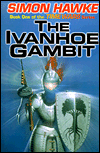
The Ivanhoe Gambit by Simon Hawke


The Time Wars series, beginning with this, the first book, is an intricate series involving time travel, psychotic villains, and intricate plots to disrupt the timestream, thus creating an alternate universe.

The basic premise is this. Sometime in the 25th century time travel was discovered. The powers that be decided to use this science for their own purposes, and created a division of the armed services, specifically with the goal of sending trained soldiers back in time to fight in armies of the past. The result of their performance was then used to determine the outcome of disagreements between countries of the present, rather than having them fight and destroy property and planet in said present.


The interesting thing is that in each of the series, the story centers around a "fictional" tale, only in the terms of the novel, the "fictional" characters were actually real persons in the past. Take for instance this one. The story centers around an nefarious plot by one person from the future, an Observer (a high-ranking official in the Time Forces), to take over as Richard III, king of England in the late 12th century, and live out his life. By doing this though, he would create the ever looming time split, because the real Richard died in battle.

Enter the Time Commandos. They go back in time and infiltrate the time line posing as Ivanhoe and Robin Hood and Little John, all of whom we take for granted as fiction, but who in terms of the series, were actually real people.

The main characters from the start are Lucas Priest and Finn Delaney, respectively "Sir Wilfred Ivanhoe" and "Little John" of Robin Hood's clan. These two and two fellow soldiers must somehow find and stop the renegade Observer. Along the way, they encounter a woman posing as a male knight, Andre de la Croix, who also becomes somewhat of an ally.


I rate the first book 8 stars.

6/10/2008

23 Minutes in Hell by Bill Wiese


If you don't believe in a Hell or some sort of eternal damnation in the afterlife, I doubt you will even take this book at face value. It is a preposterous idea, after all, that one could even experience Hell without having to die first. And the author didn't experience a typical life after death experience of the tye you hear about on the fringe radio shows like George Noory and Art Bell.


Rather, he was just asleep, on a normal night, when he found himself transferred from the present life to a cell with huge monsters. From the pain and terror he experiences there, to his brief passage by the lake of fire, what he later estimates to be the 23 minutes he spent there is an experience that is very disturbing.


Due to the fact that he was in bed prior to this gives creedence to the idea that he dreamed it all, although he on more than one occasion in the testimony portion claims it was not a dream. I personally can't say whether or not he dreamed it or not. Ron Mays, an expert on the subject makes a clear case for it being false in a review I read on Barnes and Noble. True or not, it is as scary a description as anything Stephen King could dream up.


If you are going to read it, bear in mind that only the first ¼ of the book is about his experience. The rest is devoted to his adventures in trying to get the story out. This part is fairly boring, unless you are interested in that kind of thing.

Overall I'd say the book rates about 5 stars.

6/07/2008

Mr. Monk in Outer Space by Lee Goldberg


The most recent book, at least until a little later this month, is by far the best one I've read in this series. No, our hero does not actually go into outer space here. Instead he finds himself in the baffling world of what are best described as Trekkies, although in this case, it is a fictional TV series, and not actually Star Trek fans.

Taken as a whole, the mystery and its solution are extremely satisfying, although at the outset, if one were a Trekkie, they might be offended at the cavalier way the author denigrates them. Given the fact that logic is the guiding factor of Monk, it is understandable, though, that he would find the behavior of the obsessive fans peculiar.

I still don't that the author is as good a novel writer as he is a scriptwriter (I mentioned he does scripts for the TV show, didn't I?), but then I'm not reading these books for a good well-written prose, I'm reading them because I like the TV show.

Rate this one 6½ stars.

Behind (Again)

Gotta write several reviews over the next few days. Once again I'm behind on my updates, and have been too busy to even think about them. I'll do one a day over the next few days and catch up.

5/24/2008

So You Think You Can Be President? by Iris Burnett and Clay Greager


Somewhere Will Rogers must be rolling on the floor laughing. Somehow I think the authors must have tapped into his spirit because this is without a doubt the funniest political satire in recent years.

What you get here, in the guise of a test to see if you have the makings of a politician, is some of the funniest jabs at both sides of the political aisle, that are not only dead-on, but sometimes even insighful. Especially to a person who refuses to be coerced into joining the throng on either side.

Give this one 7 stars.

5/18/2008

Armageddon in Retrospect by Kurt Vonnegut


The sage of many years for the post-WWII era, Vonnegut, who passed away last year was in his writings very anti-war, and in this group of stories it is very evident where he stands. The first piece, a letter presumably written by him shortly after his release from a German POW camp in Dresden is one of the most powerful pieces. To hear him describe the savagery of his own country's troops is jarring to say the least.

One of my favorite pieces is a story about the coming of Americans to a European city after years of that city's occupation by the Nazis and the Russians. Told from the point of view of one of the residents, a furniture maker, the commanding officer appears not much different than any of the previous occupiers to the narrator.

In all of these stories, there is a seething sense of hatred towards the military. His socialist tendencies come out well in these stories, and right-wingers in the political spectrum will probably hate the book. Tough ****. I think its a wonderful posthumous book.

Rate this one 8 stars.

5/14/2008

No-Man's Land by Scott Huler


I have never read Homer's Odyssey, although I know most of the story by way of either movies, or in discussions in grade school/high school, or vicariously through other writings in which author's have referred to it. Some of the story, thus, is news to me because I don't know the whole story.

Huler seems to have had the same story that I have, although, as he states early on, he always thought it was true when he claimed he had read the story. The initiation of the tale here is that, after finding out that he had indeed never read it, upon reading the story, he got the wild hair to actually try to retrace the journey that Ulysses did in The Odyssey.

At the outset he is hampered by the fact that he wants to spend time planning it out, but recieves word from his wife that she is pregnant. Of couse, if he scrapped plans entirely, we wouldn't have a book. Instead, he decides to try the epic journey on the fly. Using a variety of resources, and sometimes just sheer intuition, Huler makes the journey to the Mediterranean, and tries retracing the trip.

Notwithstanding that approxiamately ¾ of the book takes place in obviously mythological places, Huler nonetheless tries to approxiamate the places with real places. He often does this on the fly, and succeeds for the most part. You get a sense of the frustration that he has in trying to complete the journey, though, and it parralels quite well with how one might imagine Odysseus' frustration with trying to get home to Ithaca.

Overall, this journey/travelogue reads quite well. I rate it 7½ stars. Perhaps I ought to make reading The Odyssey a future project now.