Showing posts with label Fiction. Show all posts

3/20/2009

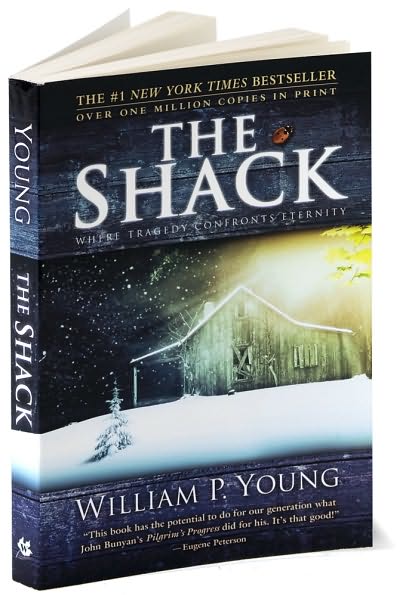
The Shack by Wm. Paul Young


This book was passed on to me from my mother, who had it passed on to her from her hairdresser. Apparently a whole hell of a lot of people are doing the same thing, because it is a fairly popular book. Why, I can't for the life of me understand.

The basic premise of the book, stated in the beginning by the author, is that a friend of his lost his youngest daughter to a child molester/killer on a weekend camping exhibition, and had totally blamed himself for the event. Four years after the fact, he receives a note, purportedly from God, asking him to spend the weekend with Him at the shack where the evidence showed his little girl had been murdered.

The book starts out interesting enough, with some background leading up to the death of his daughter, but by the time it gets to the meat of the story, my interest was rapidly replaced with disbelief, boredom, and sometimes, even outrage. I don't mean to say I couldn't accept this fictional meeting with God. (And fiction is what it is, by the way, despite the author's attempt to set it up as having really happened). What I had problems with is that this isn't the God that the Bible portrays. [Note: from here on I refuse to capitalize "god" "jesus" or "the holy spirit" intentionally, because I do not accept these characters as the Christian Trinity.]

I can't say for sure who this "god" is, although a google search for the name he gives the "holy spirit" character, Sarayu, gave me a connection to Indian theology, so maybe its a Hindu religion. Young does stick with the idea that the three characters of "god", "jesus" and "the holy spirit" are individual, but at the same time, one being, but that effort crashes and burns as he reveals characteristics about the "trinity" that one would fail to find in years of intense scrutiny of the Bible.

As far as the boredom, well, the book just drags on shortly after the main character, Mack, shows up at the shack. Most of the effort is spent in trying to justify whatever religion the author is trying to espouse. The attempt to rescue Mack from his depression is at best, mildly interesting, but it drags on for page after page.

I don't recommend this book to anyone, much less anyone who is Christian. And I will not, as the back of the book exhorts, be passing it on to others.

2 stars just to give it a rating, but don't let that influence you.

12/18/2008

The Cat's Pajamas by Ray Bradbury


Ever since I was a youngster, I wanted to write. By all accounts, ever since he was a youngster, Ray Bradbury wanted to write, too. The difference is he followed through with his dream and mine is still that. A dream. Not that anything I ever wrote would even stand up next to Bradbury. Case in point:

It was like the cracking of moon-colored ice on a midnight pond.

That line, from The Island, is the perfect example, to me, of how much of a genius Bradbury is with words.

I grew up reading Bradbury's science fiction, books like R is for Rocket and S is for Space. Those volumes only touched upon the superior ability of Bradbury to captivate his audience. Little did I know at the time, but he was more than just a science fiction writer. One only has to read Dandelion Wine to find that he should be ranked with Dickens and Twain, two of his own professed heroes.

Only a small portion of these stories are even remotely science fiction in nature. Many of them are mainstream without even a hint of science. Surprisingly, these are some of the better sories in the book, despite the fact that I have come to expect science fiction from Bradbury.

The best story in the book by my opinion is Chrysalis. If you are not familiar with Bradbury, you will not know, but it is the same title he used on a completely different story. This particular story involves the friendship between a black boy and a white boy who meet on the beach. The main character, the black boy, has been trying unsuccessfully for years to bleach the black out of his skin, while the white boy wants to get tan. The contrast is memorable as well as the reaction of certain subcharacters in the story.

There are stories that will haunt you as well as stories to amuse you here. One of the latter in particular, Hail to the Chief, involves a bunch of drunken senators who have gambled away the entire United States at an Indian gambling casino, and the President has to save their asses, not to mention reputations.

Not every story was entertaining, but in a book of short stories, I imagine most people will not like every story in it. The one titled Ole, Orozco! Sisqueros, Si! falls into this category for me. A story about a graffitti artist who gains recognition after his death.

I give this one an overall 7 stars.

12/15/2005

A Clockwork Orange by Anothony Burgess


Another in the series of books that are not part of the current reading regimen, but one of the classics of the past that influenced or affected me. (I need to come up with an alternate category title for these...)

A Clockwork Orange is a difficult book to read. Unless you are lucky enough to find a copy of the book with a glossary at the back to spell out the definitions of the gangspeak that Alex and his "droogs" (pals, gangmates...) are speaking, you will have to work at and guess some of the words meanings, but some are pretty clear, and if you have a bit of knowledge of Russian, almost all of it will be clear.

But thats not the really difficult part of the book. Whats hard is identifying Alex as a sympathetic character. He has very few scruples, and almost no moral background. In effect, he is a typical hoodlum of today. Which makes the book remarkably prescient, since in the halcyon days of the 60's when this book was written, the gang violence and unrecacitrant sociopathic teenager was probably thought of as a fantastical imagination of the author.

The book is divided into three parts ( and get the British version or the unabridged version of the American publication, I will explain later) If you've seen Stanley Kubrick's movie, the first part pretty much is followed. We see Alex and his "droogs", Pete, Georgie, and Dim doing all sorts of evil little miscreant things, leading up to his betrayal and capture by the authorities.

The second part deals with his rehabilitation, using techniques that would make liberals cringe and conservatives applaud. What is left of Alex is a shell of a man who still has some memories of his past life, but through the Pavlovian style of rehabilitation, finds it repulsive.

The third part deals with how Alex interracts with life outside the prison. Here is where I promised I would explain why to get the British version. If you've seen the movie only, it ends prematurely. The book is divided into three parts, with 7 chapters to each part. But when the American edition was released it left off the deneoument, which puts a whole new perspective on Alex.

I read this first in the American abridged version as a young man. It shaped my thoughts on society and the establishment for 15 years. Maybe it was good that I didn't get a copy of the unabridged version until my own outlook on life had softened. But when I was 30, I happened across a British edition of the book. (How it ended up in a used bookstore in Austin, I leave to you to ponder.) Anyway, I found the ending as the author originally intended even more profound.

I rate this one 7 stars for the abridged version and 8 stars for the original unabridged version.

Winthrop

11/26/2005

One Flew Over The Cuckoo's Nest by Ken Kesey


On occasion, I will reveiw books that I read years ago that had a profound effect on me and my outlook on life in general. This is one of those books.

If you've seen the movie version with Jack Nicholson, you've only gotten part of the story. Ken Kesey wrote this tale from the eyes of the Chief, a supposedly deaf-mute Native American, who in reality is neither. But this makes him a valuable eavesdropper on the events at the mental hospital at which he is a patient.

Every patient in the mental hospital is classified as either "acutes" or "chronics". The "chronics" are the ones that are considered unreformable, while the "acutes" are ones that are deemed possible to help. Each of the acutes has one common theme to their mental state, and that is how they deal with certain women in their lives. Billy Bibbit has his overbearing mother, Charlie Cheswick his philandering wife, and Dale Harding, who has never had a relationship with his wife, due to the fact that he is a homosexual, are just a few of the characters.

Over them all is Nurse Ratched, who represents everything the patients fear in women, and uses it to full effect. Into this scenario enters Randle Patrick McMurphy, the exact opposite of the inmates. He is loud, obnoxious and in his own words likes "to fight and f*** too much". He almost immediately scopes out the situation and sees Nurse Ratched for the evil figure she is, and takes it upon himself to help the inmates overcome their fear of her.

He has some success at the beginning, but then learns that he is "involuntarily committed" and as a result is wholly dependent on the Big Nurse and her staff to say when he can be released, as opposed to the rest of the acutes who are there voluntarily and can check out at their own time. This sends McMurphy into a docile state, trying to cozy up to the staff, but has the effect of dismaying and even alienating the inmates who had started to look up to him.

Throughout the entire story, you get an insight into the veiws of the Cheif (remember him, our narrator?). The whole story is full of neat little nuances and symbolism of the kind that literature majors drool over, but don't be intimidated by that. It is an excellent story, and one you will find hard-pressed to put down.

Rate this one 8½ stars.

Winthrop